Azumanga Daioh Anime Series Episode 1: Orientation (2002) – Weebz Club Score: 8/10 “A Foundation of Charm: “Orientation” lays the groundwork for a beloved slice-of-life, introducing a cast of endearing characters and their delightfully chaotic high school journey, proving that timeless humor transcends animation trends.”
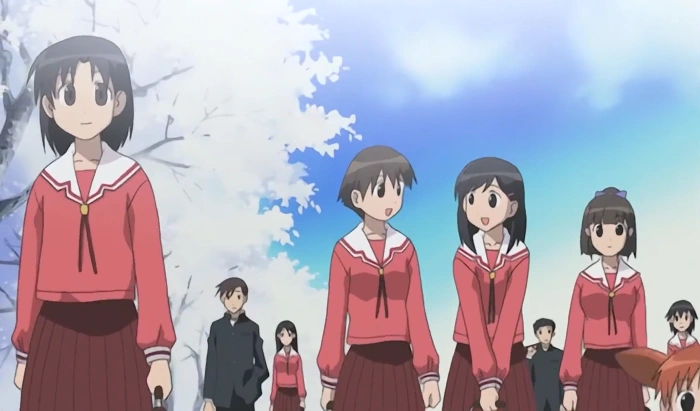
- Key Facts: Episode 1, “Orientation,” is the foundational installment of the Azumanga Daioh anime series. It introduces the six main characters: the prodigy Chiyo Mihama, the athletic and reserved Sakaki, the airheaded Osaka, the pragmatic Yomi, the boisterous Tomo, and the competitive Kagura. The episode captures their first day of high school, their initial interactions, and their introductions to a couple of notably eccentric teachers.
- Creator’s Legacy: The series is penned by Kiyohiko Azuma, the acclaimed creator of Yotsuba&!, a testament to his skill in shaping the everyday slice-of-life genre with a joyful and heart-warming tone.
- Character Focus: The strength of Azumanga Daioh lies in its exceptionally well-developed characters, whose distinct personalities and interactions form the core of the series’ humor and charm. Chiyo, in particular, is established early on as an undeniably cute and central figure.
- Timeless Appeal: While acknowledging the animation quality and trends of its 2002 release, the episode’s enduring humor and heartwarming character dynamics remain highly mentionable and enjoyable for modern viewers.
- A Matter of Taste: The series can feel somewhat chaotic at times, a characteristic that, while potentially divisive, contributes to its unique charm and is appreciated by many viewers. This episode scores an 8 out of 10.

The Dawn of a New Chapter: Welcome to High School
“Orientation,” the inaugural episode of Azumanga Daioh, masterfully sets the stage by introducing its core cast of six unique high school girls. The central focus is their collective, and individual, experiences on the very first day of high school. This pivotal moment is rendered with a gentle charm that immediately draws the viewer in. We meet Chiyo Mihama, a child prodigy who, despite her immense intellect, grapples with the social and emotional transitions of entering high school at a remarkably young age. Her presence alone injects a significant dose of cuteness, as her earnestness and innocence are palpable from the outset.
Alongside Chiyo, we are introduced to Sakaki, a quiet and athletic girl with a peculiar fondness for cats; the eccentric and airheaded Osaka, whose non-sequitur observations provide much of the series’ surreal humor; the sensible and often exasperated Yomi; the hyperactive and competitive Tomo; and Kagura, another athletic student who often finds herself caught in Tomo’s schemes. The episode skillfully contrasts these distinct personalities, showcasing how they begin to form tentative bonds and navigate the unfamiliar territory of high school life. The introductions to their teachers, particularly the perpetually unenthusiastic Yukari Tanizaki and the seemingly menacing (but ultimately harmless) Ayumu “Yocchan” Kasuga, further underscore the endearing, slightly off-kilter reality that Azumanga Daioh inhabits.
A Master’s Touch: Crafting Endearing Characters
The enduring appeal of Azumanga Daioh is deeply rooted in the brilliant character writing of Kiyohiko Azuma. Even in this first episode, the six main girls are not mere archetypes; they are individuals with distinct voices, quirks, and relatable struggles. Chiyo, as highlighted, is a perfect embodiment of youthful innocence and prodigious talent, her small stature and bright demeanor making her an immediate fan favorite. Sakaki’s quiet strength and hidden passions add a layer of depth, while Osaka’s sheer unpredictability injects a unique brand of humor that is both baffling and delightful. Yomi’s grounded reactions to the chaos around her provide an essential anchor, and the energetic duo of Tomo and Kagura bring a lively, competitive spirit to the group dynamic.
Azuma’s writing imbues these characters with a genuine warmth that resonates throughout the episode. Their interactions feel natural, capturing the awkwardness, excitement, and occasional frustration of forming new friendships. While the humor can sometimes lean into a chaotic territory, it’s this very chaos, driven by the characters’ distinct personalities clashing and converging, that defines the series. It’s a testament to Azuma’s skill that even with a relatively large cast introduced in a single episode, each character manages to make a memorable impression and establish their unique place within the narrative.

Enduring Charm in a Changing Landscape
It is important to contextualize Azumanga Daioh‘s “Orientation” within its time. Released in 2002, the animation quality and artistic trends naturally differ from contemporary anime. Viewers accustomed to the hyper-polished visuals of modern series might notice a slight lack in the animation’s fluidity or detail compared to current standards. However, this is a minor point when considering the series’ overall impact and its significant contribution to the slice-of-life genre. The charm and humor of Azumanga Daioh are remarkably timeless. The observational comedy, the character-driven gags, and the heart-warming depiction of friendship transcend the limitations of its animation era.
The “chaotic” nature that some viewers perceive is, in fact, a key element of the series’ appeal. It reflects the often unpredictable and overwhelming experience of adolescence, where moments of quiet reflection can be punctuated by sudden bursts of energy or bizarre misunderstandings. For many, this blend of the mundane and the comically absurd is precisely what makes Azumanga Daioh so endearing and memorable. “Orientation” successfully lays the foundation for this unique blend, introducing characters who, despite the passage of time and evolving animation styles, remain captivating and genuinely funny. It’s a solid debut that showcases the enduring power of well-crafted characters and a joyful, heart-warming approach to storytelling, warranting its strong reception.